Hawthorn Fruit
http://www.100md.com
《e Natural Health Center》
 |
 |
 |
Fruits
Hawthorn Fruit
Latin:
Fructus Crataegz
Origin:
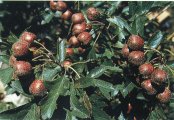
The ripe fruit of Crataegus pinnatifida Bunge (Chinese hawthorn), Crataegus pinnatifida Bunge var. major N. E. Br. (major hawthorn) or Crataegus cuneata Sieb. et Zucc. (Nippon hawthorn), a deciduous shrub or small tree, of the Rose family (Rosaceae). The first two kinds are customarily called "northern hawthorn" and the last one is normally referred to as "southern hawthorn". Native to the north temperate zone, many species are native to North America, but has spreaded to many parts of the world, including China, growing along riverbanks, on sandy soils or stony slopes.
, 百拇医药
The hawthorn's leaves are simple, and usually toothed or lobed. The white or pink flowers, usually in clusters, are followed by small applelike, red fruits, or more rarely by blue or black ones. Many cultivated varieties of hawthorn are grown as ornamentals for their attractive flowers and fruits. Some species are characterized by horizontal branching, a growth habit considered to enhance their ornamental value.
Hawthorn tree grows to about 7 m by 7 m. It is in flower in May. The scented flowers are hermaphrodite (have both male and female organs) and are pollinated by midges. The tree can grow in semi-shade (light woodland) or no shade. It requires moist or wet soil and can tolerate drought. The plant can tolerate strong winds but not maritime exposure. It can also tolerate atmospheric pollution.
, 百拇医药
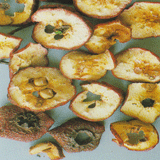
Hawthorn is produced in most areas of China. After harvested, the fruit is dried in the sun, sliced and used when raw.
Also called Haw, Chinese Haw or Thornapple.
See also Herbs, Herbs for Removing Food Stagnation, Hawthorn Fruit.
Properties:
Sour and sweet in flavor, slightly warm in nature, and related to the spleen, stomach and liver channels.
, http://www.100md.com
Functions:
Promotes digestion, removes stagnated food, activates the flow of qi, promotes blood circulation, removes blood stasis, and expels worms.
Hawthorn fruit is used for treatment of retention of meat and food in the stomach, mass in the abdomen, phlegm retention, feeling of fullness in the chest and upper abdomen, diarrhea, dysentery, lower back pain, hernia, postpartum abdominal pain, milk stagnation of babies.
, 百拇医药
Applications:
1. To treat syndromes of retention of meat and food in the stomach:
a) Abdominal distention, belching and acid regurgitation and abdominal pain with loose stools due to retention of meat and food in the stomach:
This food-herb is effective when decocted alone for oral administration or it can be used together with Chinese radish seed (Semen Raphani), medicated leaven, etc. When used alone, boil 10 g hawthorn charcoal and some brown sugar and drink.
, 百拇医药
b) More serious abdominal distention and pain due to retention of food and stagnation of qi:
It is appropriate to use this food-herb together with dried green orange peel (Pericarpium Citri Reticulatae Viride), immature citron or trifoliate orange (Fructus Aurantii Immaturus), zedoary turmeric (Rhizoma Zedoariae), etc.
2. To treat abdominal pain with diarrhea or dysentery (severe diarrhea) and hernial pain:
, http://www.100md.com
a) Abdominal pain with diarrhea or dysentery:
Parched hawthorn can be decocted in water for oral administration or the food-herb can be used together with aucklandia root, betel nuts, citron or trifoliate orange (Fructus Aurantii), etc.
b) Hernial pain:
This food-herb can be used together with tangerine seed, lychees, etc.
3. To treat chest and abdominal pain and dysmenorrhea (difficult and painful menstruation) due to blood stasis:
, http://www.100md.com
a) Postpartum (after birth) abdominal pain and persistent lochia (the vaginal discharge that takes place during the first week or two after childbirth) or dysmenorrhea due to blood stasis:
This food-herb can be decocted alone in water or used in combination with chuanxiong (Rhizoma Ligustici Chuanxiong), Chinese angelica, motherwort (Herba Leonuri), etc., for oral administration.
b) Pains in the chest and hypochondria (extreme depression) due to blood stasis:
, http://www.100md.com
This food-herb can be used together with chuanxiong (Rhizoma Ligustici Chuanxiong), peach kernels, safflower, etc.
4. To treat hypertension:
Decoct 6 g hawthorn with some rock sugar and drink the decoction.
5. To treat hypercholesterolemia (excess cholesterol in the blood) and coronary heart disease:
Boil 12 g hawthorn fruit and half sheet of lotus leaf. Drink the solution as one would tea.
, http://www.100md.com
6. For viral hepatitis (inflammation of the liver caused by virus):
Take 3 g hawthorn powder and some sugar dissolved in warm water, three times daily for a course of 10 days. Several courses may be administered.
Dosage and Administration:
10-15 g; large dosage, 30 g.
Decoct this food-herb for oral administration.
, 百拇医药
Raw hawthorn is used to promote digestion and dissipate blood stasis, while parched hawthorn is used to arrest diarrhea or dysentery.
Cautions on Use:
Reference Materials:
'Newly Revised Materia Medica' :
"Blended into juice, it is used to arrest dysentery and wash the head and body for the treatment of boils and itching."
, 百拇医药
'Supplement to Amplified Materia Medica' :
"Strengthening the stomach and reactivating stagnated qi. It will produce immediate effects after it is decocted and sugar is added."
'The Compendium of Materia Medica' :
"Promoting digestion and removing retained meat.
Toxic or Side Effects:
Modern Researches:
, http://www.100md.com
In modern times, the preparation of this food-herb produces quite good curative effects in the treatment of coronary disease, hypertension, hyperlipemia (presence of excess fat or lipids in the blood), bacillary dysentery (severe diarrhea), etc. It works to softening the blood vessels and lowering blood pressure and blood cholesterol. And it is also anti-bacterial. Traditionally, it is used to increase secretion of digestive juices, especially for the digestion of meat.
, 百拇医药
Northern hawthorn contains portein, fat, hawthorn acid, tartaric acid, citric acid, crataegolic acid, flavodic acid, lactones, saccharides, glycosides, etc.; and nippon hawthorn contains citric acid, crataegolic acid, saponin, tannate and fructose, tannin, saponin, tartaric acid, rich in vitamin C, etc.
Hawthorn can increase the secretion of digestive enzymes to promote digestion. It contains lipase, which can promote fat decomposition, and a variety of organic acids that can enhance protease (enzymes) activity to facilitate the digestion of meat and other foods.
, 百拇医药
Hawthorn can also contract the uterus, strengthen the heart, resist arrhythmia (alteration in rhythm of the heartbeat), increase blood flow in the coronary artery, dilate blood vessels, reduce blood pressure and lower blood fat.
Hawthorn has rather powerful inhibitory effects on Bacillus dysenteriae and Bacillus coli.
Reported in 'Eating Your Way to Health', 40 cases of tapeworm infection were treated by hawthorn fruit administered by eating 1,000 g fresh hawthorn (or 250 g dry hawthorn) with stones discarded. The therapy began from 3 p.m. and completed at 10 p.m. The cases fasted for dinner. On the next morning, each drank 1 cup of areca nut solution. All the cases were cured.
It was also reported that hawthorn fruit was also good at lowering serum cholesterol. Boil 50 g hawthorn and 100 g Radix Ilicis Pubescentis in 200 ml water until half volume was gone. Divide the solution into 2 equal portions. After treatment, 20 cases had their blood cholesterol lowered from 253.2 mg% to 207 mg%, a drop of 46.2 mg% on average., 百拇医药